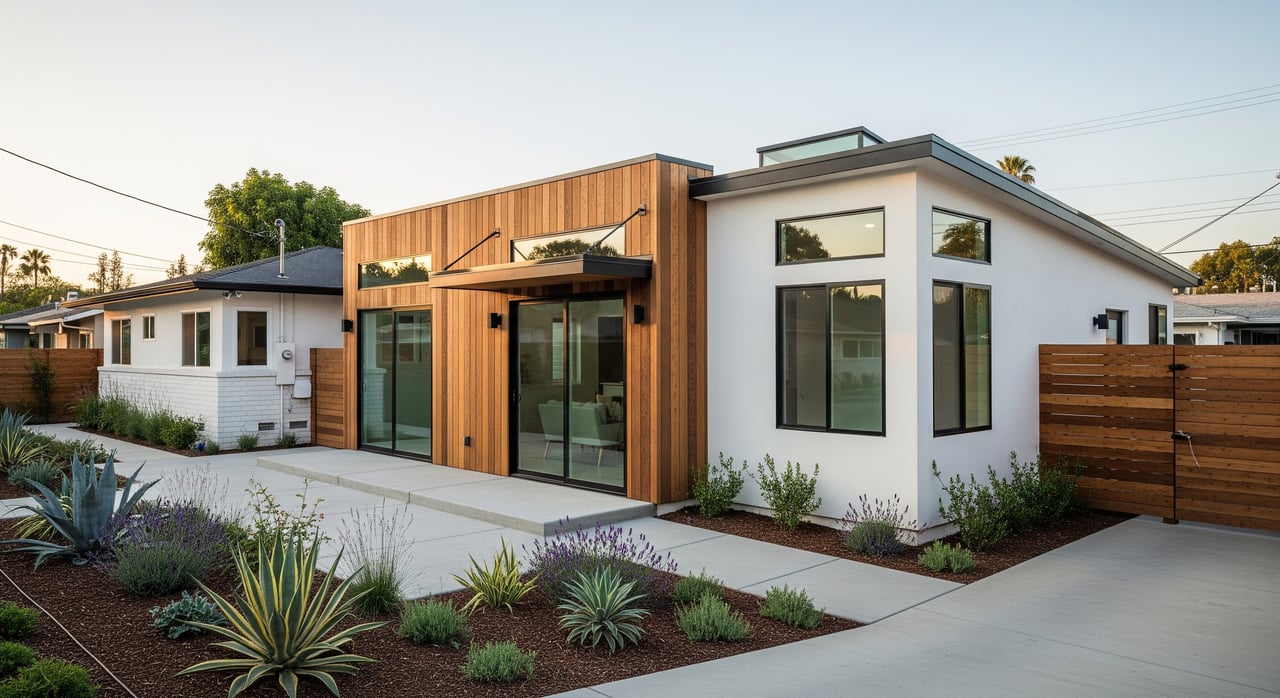
Thinking about turning your Reseda backyard or garage into income or family space? You are not alone. ADUs are one of the most flexible ways to add living area and value in Los Angeles, but the rules and costs can feel confusing at first. In this guide, you will learn how LA’s ADU rules work in Reseda, what permits you need, the typical timeline, and the biggest cost factors so you can plan with confidence. Let’s dive in.
ADU basics in Los Angeles
Accessory Dwelling Units are secondary homes on the same lot as a primary residence. In Reseda, you follow City of Los Angeles rules because Reseda sits inside the city limits.
ADU types used in Reseda
- Detached ADU: A separate structure in the yard.
- Attached ADU: An addition connected to the main home.
- Conversion ADU: An existing space, like a garage or accessory structure, converted to living space.
- Junior ADU (JADU): A small unit created within the existing home, often up to 500 sq ft, with simplified utility rules.
JADUs at a glance
JADUs are formed from interior space in the primary home, often with a separate entrance. They usually share utilities and are capped at smaller sizes than full ADUs. They can be the fastest, lowest-cost path if you have space to reconfigure inside your home.
Rules that shape your Reseda ADU
California law makes it easier to build ADUs, and the City of Los Angeles administers permits and zoning. You will work with several agencies along the way. Start with the Los Angeles Department of Building and Safety for permits and plan check, and Los Angeles City Planning for zoning and parcel details. Use the ZIMAS parcel viewer to pull your lot’s zoning and overlay info. For statewide context, review California HCD guidance on ADUs.
- Permit and plan check: Visit the Los Angeles Department of Building and Safety (LADBS) for submittal and inspections.
- Zoning and parcel research: Check Los Angeles City Planning and the ZIMAS parcel viewer to confirm zoning, setbacks, and overlays.
- Statewide basics: See California HCD’s ADU guidance for state rules that local cities must follow.
Where ADUs are allowed
Most single-family zones in Los Angeles allow ADUs, and many multi-family zones allow them too. Your exact allowances depend on your parcel’s zoning and any overlays. Confirm your lot’s eligibility and standards using the ZIMAS parcel viewer and by checking with LADBS and City Planning early in your planning.
Size and height basics
State law sets limits on how strict local rules can be, and many ADUs in Los Angeles can reach roughly 1,200 sq ft depending on the lot and context. JADUs are commonly capped near 500 sq ft. Height often depends on zoning and neighborhood context, with detached ADUs usually one to one-and-a-half stories. Always verify your parcel’s exact limits with LADBS and City Planning before you design.
Setbacks and lot coverage
Standard side and rear setbacks apply, but reduced setbacks can be available under state law in certain scenarios, especially for smaller or conversion ADUs. Lot coverage and floor-area-ratio rules may still limit where you can build. Check your parcel’s setbacks, overlays, and any special restrictions in ZIMAS and confirm with LADBS during pre-design.
Common Reseda lot considerations
Many Reseda lots have modest front yards and workable backyard space, which can make a conversion or a compact detached ADU feasible. Garage orientation to the alley or street will affect conversion and parking planning. Watch for easements, utility lines, sheds, or mature trees that can limit placement. Review recorded easements in ZIMAS and walk the site with your designer to map constraints.
Parking, utilities, and safety
ADU feasibility is more than setbacks and size. Plan early for parking, utility capacity, and life-safety requirements.
Parking and LADOT
Los Angeles often waives ADU parking in many situations set by state law, such as when an ADU is created from existing space or is near transit. Every site is unique, so confirm your specific parking obligations with City Planning and any curb-cut or driveway changes with the Los Angeles Department of Transportation. New or modified driveways can require LADOT review.
Utilities and Title 24 energy code
- Water and power: Contact the Los Angeles Department of Water & Power to confirm whether your existing meters can serve the ADU or if upgrades are needed.
- Sewer: Locate your sewer connection and confirm capacity early. If your property uses septic, separate health rules will apply.
- Electrical and gas: Your design may trigger panel upgrades or separate service runs.
- Energy efficiency: ADUs must meet California’s Title 24 energy standards for insulation, HVAC, lighting, and more. Review current rules with your designer and an energy consultant using California Energy Commission resources.
Inspections and life safety
LADBS inspects at key milestones, including foundation, framing, and final. Your ADU must meet building code standards for egress, smoke and carbon monoxide alarms, fire separation, glazing, and other life-safety items. Overlay zones can add fire or defensible-space requirements, so verify conditions for your exact parcel.
Permits and timeline in LA
For a conforming ADU that meets objective standards, approval is typically ministerial. That means no hearings and a faster path if your submittal is complete and code compliant.
Step-by-step permitting
- Preliminary parcel check: Use ZIMAS to review zoning, overlays, and setbacks, and scan LADBS and City Planning ADU guidance.
- Design: Engage an ADU-experienced architect or designer to prepare site plan, floor plans, elevations, structural concepts, and Title 24 documentation. Structural or soils reports may be needed.
- Pre-submittal: Schedule a pre-check or intake conversation with LADBS or Planning to confirm standards, documents, and whether your project qualifies for ministerial review.
- Application: Submit building permit application to LADBS along with required plans and any zoning clearance.
- Plan check: LADBS and other departments, such as Planning, LADWP, LADOT, and Sanitation, review and issue corrections.
- Permit issuance: Pull permits after addressing corrections and paying fees.
- Construction and inspections: Coordinate foundation, framing, rough MEP, and final inspections with LADBS.
- Final sign-off: Obtain final approval or a Certificate of Occupancy for the ADU.
How long it takes
- Research and design: 2 to 8+ weeks depending on complexity.
- Plan check and approval: 4 to 12+ weeks for fully compliant, ministerial projects, subject to submittal quality and agency workload.
- Construction: About 1 to 4 months for many garage conversions, and 4 to 9+ months for detached new-builds depending on scope and finishes.
- Total: Many conforming projects run 4 to 12+ months from decision to move-in.
Tips to speed approval
- Use LADBS ADU checklists and standard plan resources where applicable.
- Submit a complete, coordinated set to reduce correction cycles.
- Confirm water, sewer, and electrical capacity with LADWP before you submit.
- Work with a designer and contractor who have recent LA ADU experience.
Costs and financing in Reseda
Your budget depends on type, size, utilities, and site complexity. Labor and materials in Los Angeles also influence pricing, so secure multiple local bids.
What drives cost
- Type: Conversion ADUs often cost less per square foot than new detached builds because the structure already exists.
- Size and scope: Larger units, full kitchens, and higher-end finishes increase cost.
- Structure: New foundations, second stories, or major reframing raise costs.
- Utilities: New meters, trenching, sewer lateral work, and panel upgrades add expense.
- Access and grading: Tight sites or special staging can raise bids.
- Soft costs: Architecture, engineering, Title 24, plan check, permit fees, and inspections.
Typical ranges
- Garage conversion: Often the lowest-cost path, with totals ranging from modest tens of thousands to the low six figures depending on upgrades and finishes.
- Attached or detached new ADU: Many Los Angeles projects fall roughly in the $150 to $450+ per sq ft band based on finishes, structure, and complexity.
- JADU: Interior-only projects are typically significantly less due to smaller size and shared systems.
Always confirm fees and current code updates with LADBS and City Planning before locking your budget.
Financing options
- Cash or savings
- Home equity loan or HELOC
- Cash-out refinance
- Construction or construction-to-permanent loan
- Some state or local programs may offer incentives or favorable financing for ADUs that add to housing supply. Check California HCD and local housing pages for current programs and eligibility.
Lenders vary on how they treat projected ADU rental income, so start conversations early to clarify underwriting.
Budget surprises to plan for
- Sewer or water service upgrades
- Soil or foundation repairs discovered during construction
- Retaining walls or grading for a new footprint
- Required accessibility or fire-safety measures in some overlays
A simple action plan for Reseda
- Run your parcel on ZIMAS to confirm zoning, overlays, and easements.
- Review LADBS and City Planning ADU resources to see if your concept is likely ministerial.
- Contact LADWP to confirm water and electrical service capacity.
- Meet with an ADU-experienced designer and gather 2 to 3 feasibility and cost opinions.
- Get 2 to 3 contractor estimates for your top scenarios, such as garage conversion versus detached.
- Prepare Title 24 documentation and coordinate with your design team early.
- Review any CC&Rs or private restrictions that could limit an ADU.
How we can help
If you are exploring an ADU to create rental income, support multigenerational living, or boost resale value, you deserve clear local guidance and reliable vendor connections. Homes by Meghan and Christine pairs neighborhood insight with hands-on coordination across the Valley. We can connect you with ADU-savvy designers and contractors, discuss rental positioning and tenant placement, and provide data-backed pricing guidance when it is time to sell or refinance.
Ready to map out your Reseda ADU plan and run the numbers for your property? Connect with Meghan Nyback for a neighbor-first, full-service experience. Make that move — Get your free home valuation.
FAQs
How big can an ADU be in Reseda, Los Angeles?
- Many LA parcels allow ADUs up to roughly 1,200 sq ft, while JADUs are commonly near 500 sq ft; confirm your exact limits with LADBS and City Planning using ZIMAS.
Do I need to provide parking for an ADU in Reseda?
- Often no, because state rules limit local parking mandates in many cases, especially near transit or for conversion ADUs; verify your site with City Planning and consult LADOT for any driveway or curb changes.
What permits do I need to build an ADU in Los Angeles?
- You will submit plans to LADBS for building permits and plan check, secure any required zoning clearance, and coordinate with LADWP, LADOT, and Sanitation as needed.
How long does it take to design and build an ADU in Reseda?
- A typical conforming project runs 4 to 12+ months from research through construction, with plan check often taking 4 to 12+ weeks and build time varying by scope.
What does a garage conversion ADU typically cost in Los Angeles?
- Conversions often range from modest tens of thousands to the low six figures depending on upgrades, utilities, and finishes; get multiple local bids for accuracy.
What is a JADU and how is it different from an ADU in LA?
- A JADU is a smaller unit created within the existing home, often up to 500 sq ft with shared utilities and a separate entrance, while a full ADU can be detached or attached and larger.